Technical Debt
Technical Debt: Understanding and Managing the Cost of Quick Solutions
Introduction to Technical Debt
Technical Debt is a metaphor often used in software development to describe the extra work or complications incurred when shortcuts are taken to deliver a solution quickly. While technical debt may accelerate initial delivery, it often results in higher costs and effort in the long term due to reduced maintainability and scalability of the code.
The term was first coined by Ward Cunningham in 1992, drawing an analogy to financial debt—where borrowing may help achieve short-term goals but leads to future repayments with interest.
Types of Technical Debt
Technical debt can manifest in various forms:
- Intentional Debt: Taken on deliberately to meet tight deadlines or achieve specific business goals quickly.
- Unintentional Debt: Arises from lack of knowledge, oversight, or poor practices.
- Environmental Debt: Caused by outdated tools, frameworks, or practices.
- Architectural Debt: Results from suboptimal design decisions that hinder scalability and future development.
Causes of Technical Debt
- Pressure to Deliver Fast: Prioritizing speed over quality to meet deadlines.
- Lack of Expertise: Developers may implement solutions without fully understanding best practices.
- Changing Requirements: Frequent requirement changes can lead to incomplete or temporary fixes.
- Poor Documentation: Insufficient documentation makes it harder to update or maintain code.
- Skipping Testing: Omitting proper testing results in undetected issues that accumulate over time.
How Technical Debt Accumulates
When technical debt accumulates, it creates challenges such as:
- Slower development due to increasingly complex code.
- Higher maintenance costs as issues become harder to resolve.
- Increased risk of defects affecting end-user satisfaction.
The following chart illustrates how technical debt grows over time when not addressed:
Strategies to Manage and Reduce Technical Debt
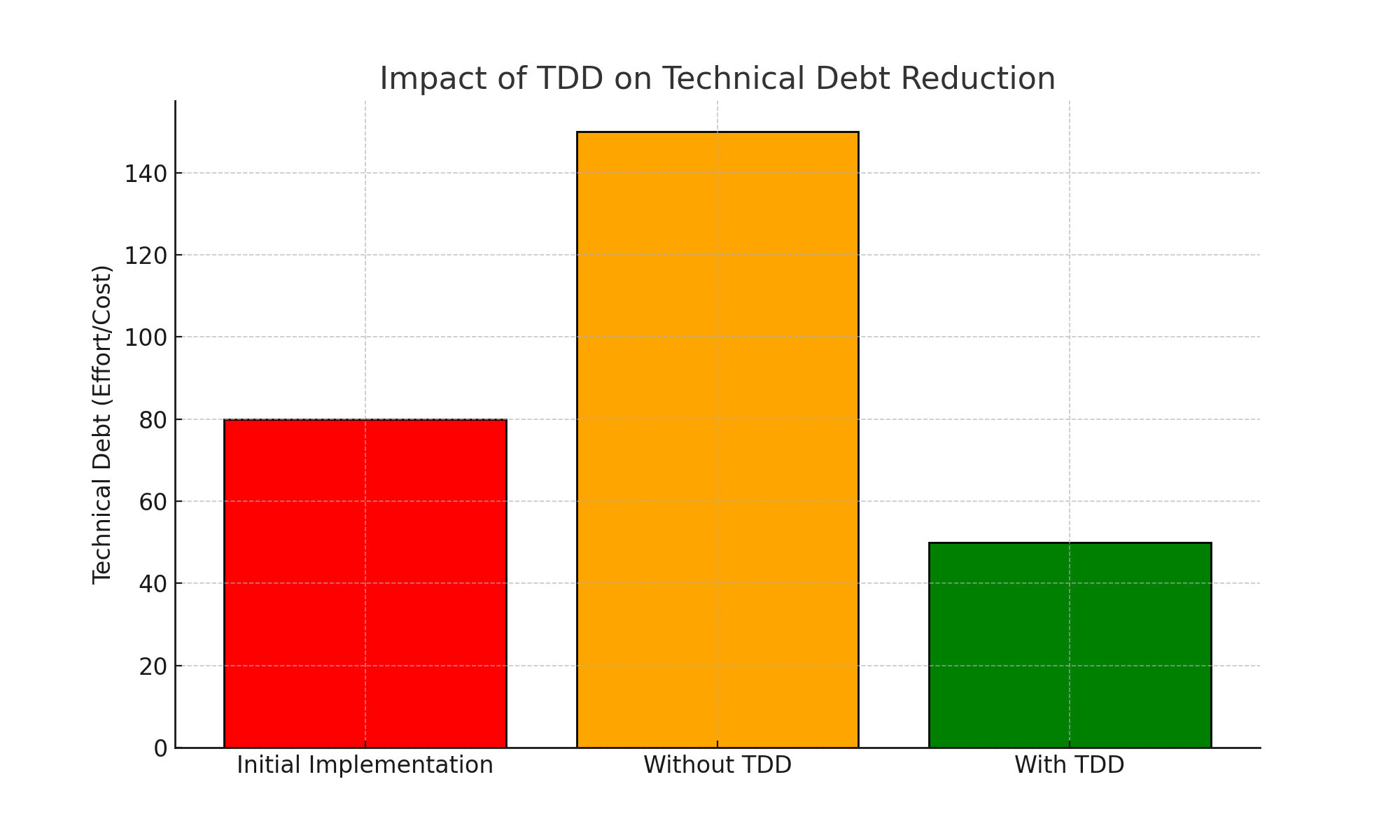
1. Adopt Test-Driven Development (TDD)
TDD helps minimize technical debt by:
- Ensuring each piece of code meets quality standards from the start.
- Facilitating regular refactoring to maintain clean code.
2. Regular Refactoring
Refactoring involves improving existing code without changing its functionality. Frequent refactoring ensures the code remains clean, maintainable, and efficient.
3. Prioritize and Document Debt
- Maintain a technical debt backlog to track known issues.
- Use priority matrices to address high-impact items first.
4. Invest in Code Reviews
Peer reviews ensure adherence to best practices and identify potential issues early, preventing debt accumulation.
5. Leverage Automated Tools
Automated tools like SonarQube or CodeClimate can:
- Analyze code for maintainability.
- Identify areas requiring refactoring.
- Provide metrics to track progress in reducing debt.
6. Balance Speed and Quality
Avoid sacrificing long-term quality for short-term speed. Encourage collaborative decision-making between developers and stakeholders to align on realistic timelines.
Practical Example
Imagine a team working on an e-commerce website. Due to tight deadlines, they hard-code tax calculations for different regions rather than building a scalable, dynamic solution. While this approach works initially, adding new regions or tax rules becomes cumbersome. Over time, maintaining this code increases effort and risk, illustrating how technical debt accrues.
Addressing this debt involves:
- Refactoring the tax calculation logic to a configurable system.
- Adding automated tests to prevent future issues.
Impact of Technical Debt on Projects
Unchecked technical debt can lead to:
- Reduced Productivity: Developers spend more time fixing issues than creating new features.
- Diminished Quality: Code becomes harder to test, leading to defects in production.
- Lower Morale: Developers may feel frustrated working with unmanageable code.
- Higher Costs: Maintenance and debugging costs increase over time.
Technical Debt vs. Financial Debt
| Aspect | Technical Debt | Financial Debt |
|---|---|---|
| Definition | Cost of shortcuts in software development. | Money borrowed that must be repaid with interest. |
| Impact | Leads to increased development and maintenance effort. | Results in financial obligations and interest payments. |
| Management | Requires regular refactoring and best practices. | Requires timely repayments and financial planning. |
Conclusion
Technical debt is an unavoidable reality in software development, but it can be managed effectively with the right practices. By adopting proactive strategies like TDD, regular refactoring, and leveraging automated tools, teams can reduce the burden of technical debt and ensure long-term success. Treating technical debt as a strategic priority aligns development efforts with organizational goals, ultimately delivering higher-quality software that meets user needs.