
Project Victor Learning Hub
Menu
Get Certified

The Biggest PMP Study Mistake People Make After Finishing a Bootcamp

Most PMP candidates fail after a bootcamp for one reason. They switch from structured learning to unstructured effort.

They feel prepared. They start doing random questions. They stop reviewing by task. They rely on instinct.

PMP does not test memory. PMP tests decisions under pressure. Most questions use scenarios. They measure judgment, priority, and action choice.

Four mistakes explain most failures. Fix them and results improve fast.
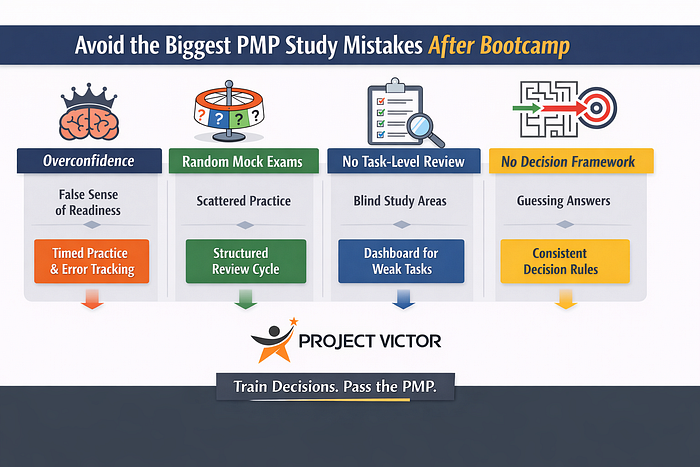
Biggest PMP Study Mistakes After Bootcamp

Overconfidence

Bootcamps create clarity. Clarity feels like readiness.

Readiness needs proof. Proof means performance under time pressure.

What overconfidence looks like
• Delaying practice after the bootcamp
• Rereading notes instead of answering questions
• Avoiding timed sets
• Expecting confidence to appear during the exam

Why this fails
• Familiarity feels like mastery
• Passive review inflates confidence
• Pressure exposes weak decision habits

What to do instead
• Start practice within 24 hours after training
• Use short timed sets every day
• Track errors by task and decision type
• Let results guide focus

Random mock exams

Many candidates jump from one mock exam to another. Scores stay flat. Anxiety grows.

Random practice creates activity without improvement.

What this looks like
• Using multiple simulators at the same time
• Taking full exams too early
• Checking scores without reviewing decisions
• Skipping deep review to save time

Why this fails
• The same thinking errors repeat
• Root causes stay hidden
• Endurance trains before decision quality

What to do instead

Use one practice cycle. Repeat it every time.

Practice cycle
• Run a timed set of 30 to 60 questions
• Review every wrong and guessed answer
• Write one decision rule per mistake
• Drill similar questions immediately

Common error tags
• Missed the real question
• Acted without assessing first
• Escalated too early
• Ignored stakeholder impact
• Mixed agile and predictive logic
• Violated PMI ethics or values

This turns practice into skill building.

No task-level review

PMP aligns to domains and tasks. Overall scores hide weak areas.

Weak tasks cause failure. Strong tasks do not save weak ones.

What this looks like
• Studying by domain name only
• Using one average score to plan
• Repeating full mocks without fixing patterns

What to do instead

Build a one-page dashboard.

Dashboard fields
• Domain
• Task or topic
• Accuracy percentage
• Confidence level
• Repeated mistake type

Focus rules
• Fix weak tasks first
• Protect strong tasks with spaced review
• Stop reviewing content you answer correctly under time

Precision beats volume.

No decision framework

This is the biggest issue.

Candidates know terms. They do not know how PMI expects decisions.

A framework removes guessing. It keeps answers consistent.

A practical PMP decision framework

Step 1
Identify the real ask. First action. Next step. Best response.

Step 2
Classify the situation. People issue. Process issue. Business constraint.

Step 3
Choose the leadership stance.
Collaborate. Engage. Clarify. Coach.
Avoid blame and command style.

Step 4
Apply common PMP action patterns
• Assess before acting when facts lack clarity
• Prevent risks before fixing damage
• Communicate early with the right stakeholder
• Use change control for baseline changes
• Remove impediments in agile settings

Step 5
Eliminate wrong options fast

Red flags
• Fire or replace as first response
• Escalate to sponsor immediately
• Add people to recover schedule
• Push overtime as main solution
• Ignore process in predictive projects
• Ignore collaboration in agile teams

Turn every wrong answer into a reusable rule.

Exam execution matters

The exam runs long. Fatigue affects judgment.

Train in blocks. Build stamina only after decision quality improves.

Better targets
• Stable performance under time
• Fewer guesses on scenario questions
• Consistent accuracy across tasks

A 90-day post-bootcamp plan

Days 1–30. Build control and visibility.

Goal
Replace confidence with evidence. Expose weak tasks early.

Weekly focus
Accuracy before volume.

Daily actions
• 30 to 60 timed questions
• One simulator only
• Full review of all wrong and guessed answers

Review discipline
• Tag every question by domain and task
• Write one short decision rule per mistake
• Record why the chosen option failed

End-of-month targets
• Clear list of weak tasks
• Stable timing per question
• Fewer pure guesses

What to avoid
• Full mock exams
• Reading notes without practice
• Switching simulators

Days 31–60. Fix weak tasks and decision patterns.

Goal
Turn weak tasks into stable performers.

Weekly focus
Precision and repetition.

Daily actions
• 60 to 90 questions
• Question sets built only from weak tasks
• Mix People, Process, Business scenarios

Structured practice cycle
• Timed set
• Deep review
• Update decision rules
• Immediate drill on the same mistake type

Decision framework reinforcement
• Assess before acting
• Collaborate before escalating
• Prevent before correcting
• Respect change control
• Align with PMI ethics and values

End-of-month targets
• Weak tasks reduced by half
• Consistent accuracy under time
• Clear instinct alignment with PMI logic

What to avoid
• Chasing high scores
• Ignoring strong areas completely
• Long study days with no review

Days 61–90. Build endurance and exam readiness.

Goal
Perform consistently for the full exam duration.

Weekly focus
Execution under fatigue.

Practice structure
• Two 60-question blocks back to back
• Full review on the same day
• Error pattern tracking

Full simulations
• One full mock every 10 to 14 days
• Two-day review after each full mock
• Focus only on repeat mistakes

Exam rhythm training
• Break strategy
• Energy management
• Question pacing control

Final 14 days
• No new content
• No random exams
• Only repeat error patterns
• Light daily practice
• Confidence through consistency

Final readiness signals
• Stable scores across all domains
• Few guessed answers
• Calm decision making under time

🎓 How Project Victor Helps You Get PMP® Certified

Project Victor is Thailand’s #1 PMP® Training Provider and a PMI Authorized Training Partner (ATP). We help professionals in Thailand pass the PMP® exam with confidence through:

35-hour PMP® Exam Prep Bootcamps
(Live in-class or online | Available in Thai and English)

One-on-one support for application review & PMI eligibility
PMP® Exam Simulator with over 3,000+ practice questions
Private coaching sessions with PMI-authorized instructors

📞 Ready to start your PMP® journey?

🌐 Website: www.projectvictor.com
📱 LINE Official: @projectvictor
📞 Tel: +66 92 348 4772

Disclaimer

“PMBOK”, “PMP”, and “PMI” are registered trademarks of the Project Management Institute, Inc. This article is independently written for educational purposes and is not affiliated with or endorsed by PMI.

PMP Certificate Audit Requirements

Understanding the PMI Audit Process: A Guide for PMP® Applicants in Thailand

If you’re applying for the PMP® (Project Management Professional) certification in Thailand, it’s important to understand the PMI audit process. This article will simplify the key steps, provide practical examples, and offer tips to ensure your application process goes smoothly.


What is the PMI Audit Process?

The PMI audit process is a random quality assurance measure to verify the information provided in your application. While not every applicant will undergo an audit, it’s essential to be prepared as part of the certification process.

When you apply for the PMP® exam, you’ll need to provide documentation of your education, professional experience, and project management training. If your application is selected for an audit, you’ll need to submit additional documents to validate the details you entered.


Steps in the PMI Audit Process

  1. Application Submission
    After completing your PMP® application on the PMI website, your information will be reviewed. If selected for an audit, you will receive an email notification before paying the certification fee.
  2. Audit Notification
    PMI will email you with instructions for the audit process, including what documents you need to submit. For example:

    • Diplomas or Degree Certificates: A copy of your bachelor’s degree (or global equivalent).
    • Experience Verification: Signed letters from supervisors for the projects listed in your application.
    • Training Certificates: Proof of your 35 contact hours of project management education (e.g., a certificate from a PMP bootcamp held in Bangkok).
  3. Document Submission
    You will have 90 days to gather and submit the required documents. Upload the documents to your audit package on your mypmi.org dashboard.
  4. Audit Review
    PMI will review your documents, which typically takes 5–7 business days. If everything is in order, you’ll be approved to proceed with the exam.
  5. One-Year Eligibility Period
    Once you pass the audit, you will have one year to schedule and take your PMP® exam.

Practical Example for Applicants in Thailand

Let’s say you’re based in Bangkok and applying for the PMP® certification. Here’s what the process might look like:

  • Education Documentation: Submit a scanned copy of your degree from a Thai university, such as Chulalongkorn University or Assumption University.
  • Experience Verification: If you worked as a project manager for a Bangkok-based IT firm, ask your manager to sign an experience verification letter detailing your role and responsibilities.
  • Training Hours: If you attended a PMP® bootcamp in Thailand, such as one organized by Project Victor Co., Ltd., include your certificate showing the completion of 35 contact hours.

Tips for a Smooth PMI Audit Process

  1. Prepare Documents in Advance
    Keep all your diplomas, certificates, and signed experience letters ready before submitting your application.
  2. Work Closely with Supervisors
    Ensure your past supervisors are aware of the audit process and are prepared to sign your experience verification documents if required.
  3. Choose Reliable Training Providers in Thailand
    Attend a PMI-approved training program like those offered in Bangkok to ensure your contact hours are recognized.
  4. Respond Quickly
    If you’re selected for an audit, don’t wait until the last minute to submit your documents. The faster you comply, the sooner you can move forward.

What Happens If You Don’t Pass the Audit?

Failing to meet the audit requirements or choosing not to comply results in a one-year suspension before you can reapply. This emphasizes the importance of accuracy and honesty in your application.


FAQs for PMP® Applicants in Thailand

1. How likely is it to be selected for an audit?
The selection process is random, but all applications from PMI employees or volunteers are audited.

2. How can I prepare for an audit?
Maintain organized records of your education, project experience, and training certificates. Ensure all documents match the details provided in your application.

3. What if my documents are in Thai?
If your documents are in Thai, have them translated into English by a certified translator to ensure compliance with PMI requirements.


By understanding and preparing for the PMI audit process, PMP® applicants in Thailand can confidently navigate their way toward certification. If you need training or guidance, consider joining a PMP® course in Bangkok to ensure your application meets PMI standards.

For more information, visit Project Victor Co., Ltd. – a trusted provider of PMP® training in Thailand!

Failing the PMP Exam

What Happens If You Fail the PMP® Exam? A Guide for Candidates in Thailand

Failing the PMP® (Project Management Professional) exam can be disheartening, but it’s important to remember that you’re not alone, and you still have opportunities to succeed. The Project Management Institute (PMI) offers clear guidelines for retaking the exam, making it possible to turn this setback into a learning experience.

Here’s everything you need to know about retaking the PMP® exam, with practical tips and advice for candidates based in Thailand.


What To Do After Failing the PMP® Exam

If you fail the PMP® exam, PMI allows you to reapply and take the exam again within one year from the date of your last attempt. Here’s how it works:

  1. Re-Examination Fee:
    Candidates pay a reduced re-examination fee compared to the initial exam fee. For current pricing, check PMI’s official website or consult your local training provider in Thailand.
  2. Number of Attempts:
    You can retake the exam as often as you wish within the one-year eligibility period. PMI allows a maximum of three attempts during this time.
  3. Re-Application Timeline:
    You can apply for re-examination at any time within the eligibility period. However, it’s recommended to spend sufficient time preparing before scheduling your next attempt.

Steps to Retake the PMP® Exam

  1. Analyze Your Exam Performance:
    • After failing, PMI provides a performance report highlighting the areas where you need improvement.
    • Focus on the Domains (e.g., People, Process, Business Environment) where your performance was below target.
  2. Plan Your Preparation:
    • Revisit your study materials, especially areas identified as weak in your performance report.
    • Consider enrolling in a PMP® Exam Prep Bootcamp in Bangkok or an online course tailored to your needs.
  3. Practice Makes Perfect:
    • Use PMP® simulation exams and mock tests to build confidence.
    • Practice time management to ensure you can complete all 180 questions during the exam.
  4. Reapply for the Exam:
    • Log in to your PMI account, pay the re-examination fee, and schedule your next attempt at a Pearson VUE test center in Thailand or as an online proctored exam.

Practical Example: Retaking the PMP® Exam in Thailand

Let’s consider Somchai, a project manager from Bangkok. After failing his first attempt, he realized he struggled with the People domain questions. He reviewed his performance report and took the following steps:

  • Joined a PMP® Bootcamp in Bangkok: Somchai enrolled in a focused training program to improve his understanding of leadership and stakeholder management.
  • Used Mock Exams: He completed weekly practice tests to track his progress (e.g. Project Victor Exam Simulator).
  • Scheduled His Retake: After three months of preparation, he applied for a re-examination and passed successfully on his second attempt.

Tips to Increase Your Chances of Success

  1. Review the PMBOK® Guide and Exam Content Outline:
    These are the foundation of the PMP® exam and should be your primary study resources.
  2. Join a Study Group:
    Connect with PMP® aspirants in Thailand to share insights and clarify concepts (e.g. Project Victor Facebook Group).
  3. Use Local Resources:
    Attend workshops or seminars hosted by PMI Thailand Chapter or training providers like Project Victor Co., Ltd. for guidance tailored to Thai candidates.
  4. Focus on Mock Exams:
    Simulating real exam conditions can help you identify gaps and improve time management (e.g. Project Victor Exam. Simulator).

FAQs for PMP® Candidates in Thailand

1. Can I retake the exam after one year?
If your one-year eligibility period expires, you must submit a new application and meet PMI’s requirements again.

2. How much does the re-examination fee cost?
The fee is reduced compared to the initial exam fee. Check PMI’s website for the latest pricing.

3. Can I switch to an online proctored exam?
Yes, you can choose between an online proctored exam or a test center in Thailand, such as Pearson VUE centers in Bangkok.


Final Thoughts

Failing the PMP® exam is not the end of your journey—it’s a chance to learn and improve. With a structured plan, the right resources, and determination, you can successfully pass the exam and earn your PMP® certification.

If you’re based in Thailand, consider leveraging local resources like Project Victor Co., Ltd., a leading provider of PMP® training, to support your success. Remember, failure is just a stepping stone to achieving your goals!