CYNEFIN Framework
Understanding the CYNEFIN Framework and Problem Complexity
The CYNEFIN Framework (pronounced kuh-NEV-in) is a decision-making tool that helps teams and leaders understand the nature of their work or challenges and determine the best approach to manage them. Developed by Dave Snowden, it divides complexity into five domains, offering guidance on how to navigate uncertainty and make informed decisions.
What Is the CYNEFIN Framework?
The CYNEFIN Framework organizes problems into five domains based on the level of complexity and uncertainty:
- Clear Domain
- Complicated Domain
- Complex Domain
- Chaotic Domain
- Confused Domain (Center)
Each domain requires a specific approach to problem-solving and decision-making.
The Five Domains of the CYNEFIN Framework
1. Clear Domain
- Characteristics:
- The relationship between cause and effect is well-understood.
- Problems are straightforward, and solutions are repeatable.
- Approach:
- Follow best practices and standard operating procedures.
- Example:
- Industry: Retail
- Scenario: Processing routine customer returns with established policies.
2. Complicated Domain
- Characteristics:
- Cause and effect are known but require analysis or expertise to identify.
- Multiple correct solutions may exist.
- Approach:
- Rely on expert knowledge and analysis.
- Example:
- Industry: Healthcare
- Scenario: Diagnosing a non-critical illness using medical tests and expert consultation.
3. Complex Domain
- Characteristics:
- Cause and effect are only clear in hindsight.
- Solutions emerge through experimentation and adaptation.
- Approach:
- Use Agile methods, experiment, and learn from feedback.
- Example:
- Industry: Technology
- Scenario: Developing a new social media platform where user behavior and preferences are unpredictable.
4. Chaotic Domain
- Characteristics:
- Cause and effect are unclear, and the situation is highly volatile.
- Immediate action is needed to stabilize the environment.
- Approach:
- Act decisively to contain chaos, then assess and adapt.
- Example:
- Industry: Emergency Response
- Scenario: Responding to a natural disaster and coordinating immediate relief efforts.
5. Confused Domain (Center)
- Characteristics:
- The situation is unclear, and the appropriate domain is not yet determined.
- Approach:
- Break down the problem and determine which domain it belongs to.
Using CYNEFIN in Project Management
The CYNEFIN Framework is particularly valuable in project management, where uncertainty and complexity often vary across different aspects of a project. Here’s how to apply it:
- Assess the Domain:
- Identify where each aspect of the project fits within the CYNEFIN Framework.
- Adopt the Right Approach:
- Clear Domain: Follow established project management templates and workflows.
- Complicated Domain: Consult experts to develop a well-informed plan.
- Complex Domain: Use Agile or iterative approaches to adapt as you learn.
- Chaotic Domain: Focus on immediate stabilization before long-term planning.
- Adjust Strategies:
- Be prepared to shift domains as new information emerges. For example, a project might start in the Complex Domain and move to the Clear Domain as clarity improves.
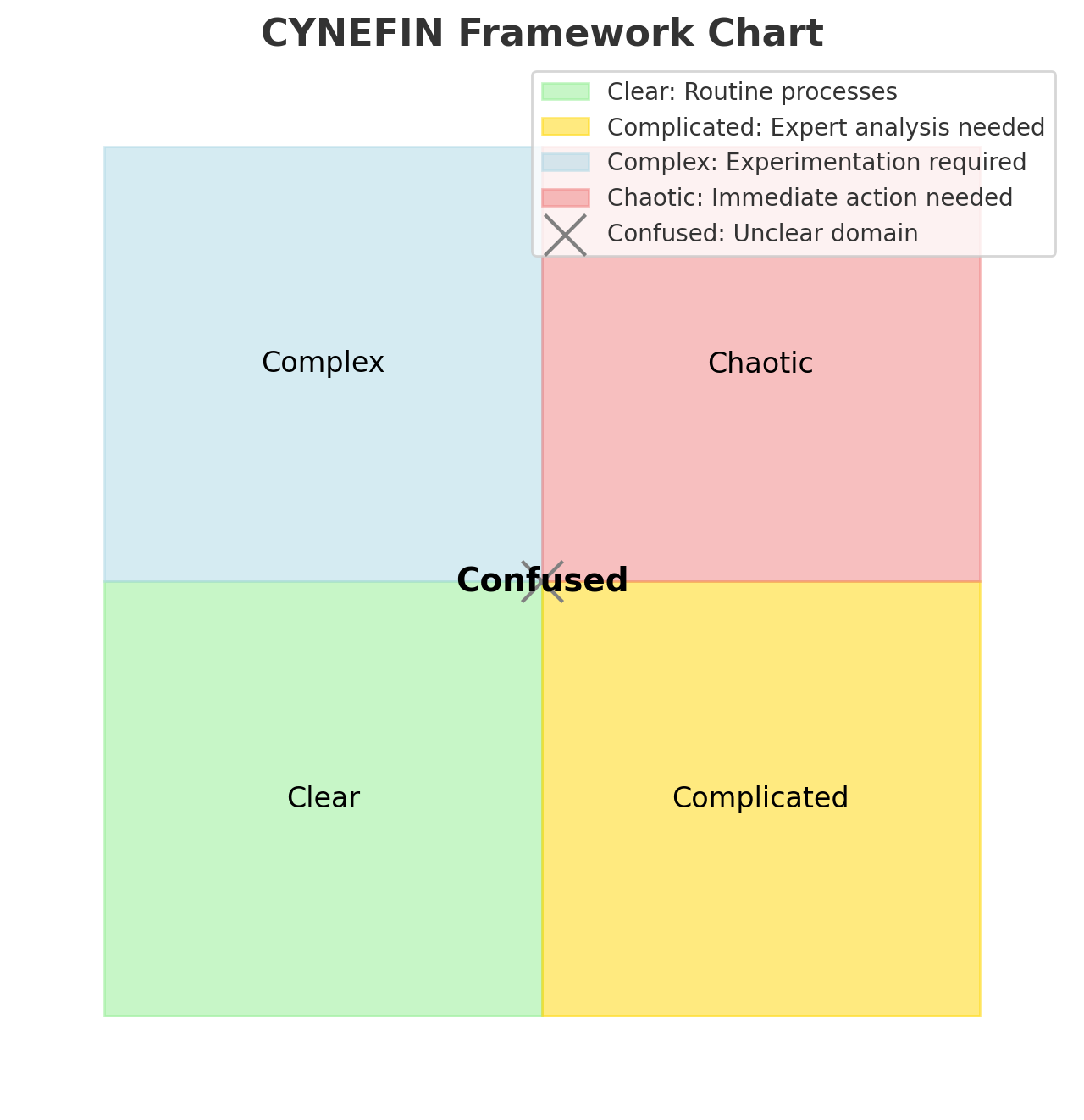
Practical Example Chart
Visual Description: A circular chart with five segments representing the CYNEFIN domains:
Each domain is labeled with its characteristics and examples, and arrows indicate potential movement between domains as understanding evolves.
Example Chart:
Example Across Industries
1. Clear Domain
- Industry: Hospitality
- Scenario: Housekeeping follows a checklist to clean rooms.
2. Complicated Domain
- Industry: Aerospace
- Scenario: Designing an airplane component based on engineering calculations.
3. Complex Domain
- Industry: Marketing
- Scenario: Launching a viral marketing campaign where user reactions are uncertain.
4. Chaotic Domain
- Industry: Crisis Management
- Scenario: Managing a sudden PR crisis after a product recall.
5. Confused Domain
- Industry: Cross-Functional Projects
- Scenario: Addressing conflicting stakeholder requirements in a new initiative.
Conclusion
The CYNEFIN Framework is a versatile tool that helps teams and leaders navigate uncertainty and complexity in their work. By categorizing problems into Clear, Complicated, Complex, Chaotic, or Confused domains, it provides actionable guidance for choosing the right approach. In project management, CYNEFIN ensures that strategies align with the nature of the work, enabling teams to adapt and succeed in diverse environments.