Project Victor Learning Hub
Menu
Get Certified

Directions of Influence

Directions of Influence in Project Management

Understanding the directions of influence is a key component of effective stakeholder management in project management. It provides insight into how stakeholders impact a project and, conversely, how the project influences them. This understanding is crucial for developing effective communication and engagement strategies.

What Are Directions of Influence?

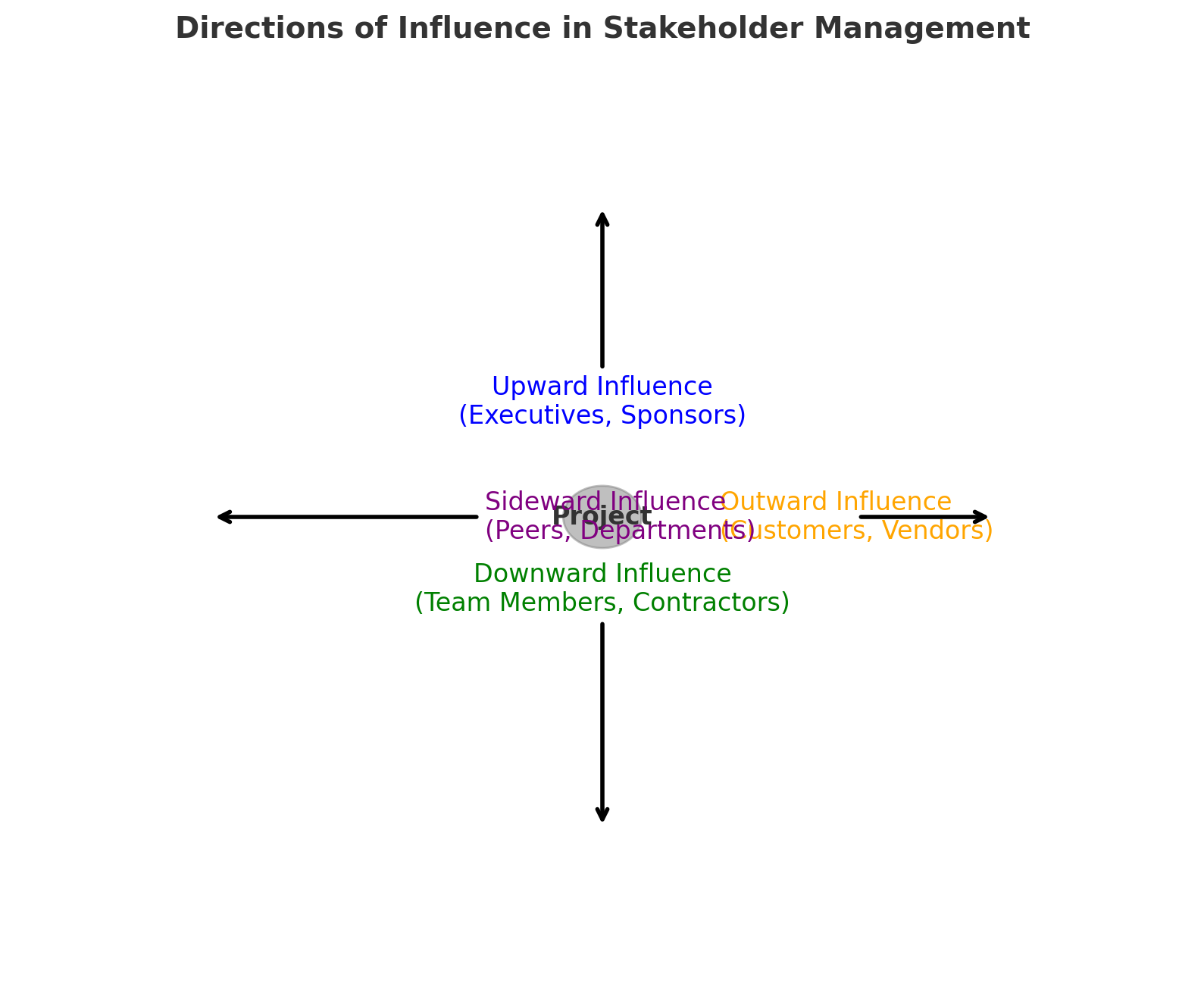
Directions of influence categorize stakeholders based on their relationship to the project and their ability to impact or be impacted by it. The four primary directions of influence are:

  1. Upward Influence: Stakeholders with authority over the project, such as executives, sponsors, and regulatory bodies.
  2. Downward Influence: Stakeholders directly accountable to the project, including project team members and contractors.
  3. Outward Influence: External entities affected by or impacting the project, such as customers, suppliers, competitors, and the public.
  4. Sideward Influence: Peers or stakeholders at the same organizational level, including other project managers, teams, or departments.

Using Directions of Influence in Stakeholder Analysis

  1. Identify Stakeholders:
    • List all individuals, groups, or organizations involved in or affected by the project.
  2. Categorize Stakeholders:
    • Classify each stakeholder based on their direction of influence.
  3. Analyze Relationships:
    • Understand the nature of their influence and their impact on project objectives.
  4. Prioritize Engagement:
    • Focus on stakeholders whose influence aligns closely with project success.
Practical Examples in Different Industries

Construction Industry

  • Scenario: Building a commercial complex.
  • Upward Influence: Local government approving zoning and permits.
  • Downward Influence: Contractors and labor teams executing construction tasks.
  • Outward Influence: Nearby businesses affected by construction noise and traffic.
  • Sideward Influence: Architects and engineers working on concurrent projects.

Healthcare Industry

  • Scenario: Implementing a new patient management system.
  • Upward Influence: Hospital executives deciding on project funding.
  • Downward Influence: IT and medical staff adapting to the new system.
  • Outward Influence: Software vendors providing the platform.
  • Sideward Influence: Departments competing for budget allocation.

Technology Industry

  • Scenario: Launching a new mobile application.
  • Upward Influence: Investors and stakeholders expecting ROI.
  • Downward Influence: Development and QA teams building and testing the app.
  • Outward Influence: End users providing feedback and shaping the roadmap.
  • Sideward Influence: Marketing and sales teams coordinating the launch.

Case Study: Directions of Influence in a Thai Project

Project: Expanding Public Transportation in Bangkok

  • Scenario: Developing a new metro line to improve urban mobility.
  • Upward Influence: The Thai government and municipal authorities funding and regulating the project.
  • Downward Influence: Construction firms and local contractors building the infrastructure.
  • Outward Influence: Residents and businesses affected by construction and traffic disruptions.
  • Sideward Influence: Project managers overseeing parallel infrastructure upgrades, such as roads and bridges.
  • Outcome: By addressing each direction of influence, the project team successfully navigated regulatory requirements, minimized public disruptions, and delivered the metro line on schedule.

Best Practices for Managing Directions of Influence

  1. Map Stakeholders:
    • Use tools like stakeholder maps or grids to visualize the directions of influence.
  2. Develop Tailored Strategies:
    • Create specific engagement plans for each direction of influence.
    • Example: For upward influence, provide high-level status updates; for downward influence, offer detailed guidance and resources.
  3. Foster Communication:
    • Establish open channels for feedback and collaboration.
  4. Monitor and Adapt:
    • Continuously assess and adjust stakeholder strategies based on project dynamics.

Benefits of Understanding Directions of Influence

  1. Enhanced Communication:
    • Tailor messages to resonate with each stakeholder group.
  2. Improved Collaboration:
    • Align stakeholder efforts toward common goals.
  3. Proactive Risk Management:
    • Identify and mitigate stakeholder-related risks early.
  4. Increased Stakeholder Satisfaction:
    • Address concerns effectively, fostering trust and support.

Conclusion

Understanding directions of influence is essential for effective stakeholder management in project management. By analyzing upward, downward, outward, and sideward influences, project managers can develop tailored strategies to engage stakeholders, ensure alignment with project objectives, and navigate complex stakeholder relationships. Practical applications across industries, including a metro expansion project in Thailand, demonstrate the value of this approach in achieving successful project outcomes.
Salience Model

The Salience Model in Stakeholder Analysis and Stakeholder Mapping

The Salience Model is a vital framework in project management for analyzing and mapping stakeholders. By categorizing stakeholders based on their attributes of power, legitimacy, and urgency, the Salience Model helps project managers prioritize stakeholder engagement and address their needs effectively. This ensures that projects align with stakeholder expectations and avoid unnecessary conflicts.

Understanding the Salience Model

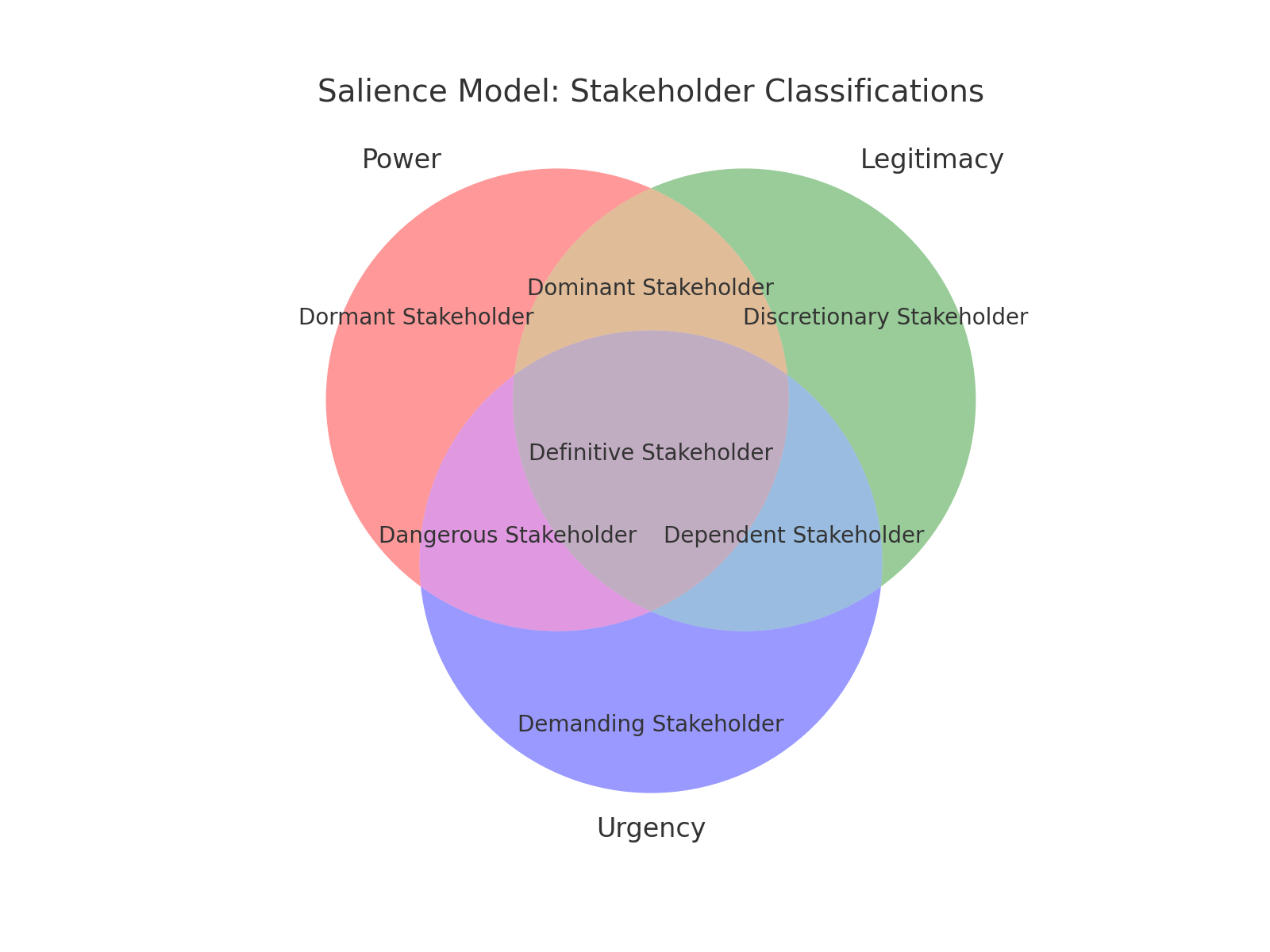
The Salience Model identifies and categorizes stakeholders into seven distinct types based on three key attributes:

  1. Power: The stakeholder’s ability to influence the project or its outcomes.
  2. Legitimacy: The stakeholder’s involvement or claim in the project’s objectives.
  3. Urgency: The stakeholder’s immediate need for attention or action regarding the project.

The intersection of these attributes creates the following stakeholder categories:

  1. Dormant Stakeholders: Possess power but lack legitimacy and urgency.
  2. Discretionary Stakeholders: Have legitimacy but no power or urgency.
  3. Demanding Stakeholders: Exhibit urgency but lack power and legitimacy.
  4. Dominant Stakeholders: Hold both power and legitimacy.
  5. Dangerous Stakeholders: Combine power and urgency but lack legitimacy.
  6. Dependent Stakeholders: Have legitimacy and urgency but no power.
  7. Definitive Stakeholders: Possess all three attributes and require the highest attention.

Using the Salience Model in Stakeholder Analysis

  1. Identify Stakeholders:
    • List all individuals, groups, or organizations with an interest in the project.
  2. Assess Attributes:
    • Evaluate each stakeholder’s power, legitimacy, and urgency.
  3. Categorize Stakeholders:
    • Place stakeholders in the appropriate category based on their attributes.
  4. Prioritize Engagement:
    • Focus on definitive stakeholders while addressing others proportionally to their impact on the project.
  5. Develop a Stakeholder Management Plan:
    • Tailor strategies to engage each category of stakeholders effectively.

Using the Salience Model in Stakeholder Mapping

Stakeholder mapping visualizes stakeholder categories, helping project teams strategize communication and engagement efforts. Typically, a Venn diagram is used to depict the overlapping attributes of power, legitimacy, and urgency, with definitive stakeholders at the center.

Practical Examples of the Salience Model

Construction Industry

  • Scenario: Building a residential complex.
  • Stakeholders:
    • Dormant Stakeholder: Local government with zoning power but no immediate involvement.
    • Dominant Stakeholder: Investors funding the project, holding both power and legitimacy.
    • Definitive Stakeholder: Residents impacted by construction timelines, possessing power, legitimacy, and urgency due to quality-of-life concerns.

Healthcare Industry

  • Scenario: Implementing a new hospital information system.
  • Stakeholders:
    • Discretionary Stakeholder: Health advocacy groups with legitimate interest but no power or urgency.
    • Dangerous Stakeholder: Cybersecurity experts raising immediate concerns about system vulnerabilities.
    • Definitive Stakeholder: Hospital management requiring timely implementation to improve operations.

IT Industry

  • Scenario: Developing a mobile app.
  • Stakeholders:
    • Demanding Stakeholder: Users requesting a feature enhancement but lacking power and legitimacy.
    • Dependent Stakeholder: Early adopters advocating for specific changes, with legitimacy and urgency but no power.
    • Definitive Stakeholder: The client funding the app development with vested power, legitimacy, and urgency.

Case Study: Salience Model in a Thai Project

Project: Upgrading Public Transportation in Bangkok

  • Scenario: A project to enhance Bangkok’s metro system with new trains and upgraded stations.
  • Stakeholders:
    • Dormant Stakeholder: Foreign equipment suppliers with power to influence pricing but no local involvement.
    • Dominant Stakeholder: Bangkok Metropolitan Administration (BMA) responsible for project oversight.
    • Dependent Stakeholder: Commuters advocating for improved service but lacking direct influence.
    • Definitive Stakeholder: Government agencies funding the project and demanding timely delivery due to political commitments.
  • Outcome: The Salience Model guided the project team to focus engagement on definitive stakeholders while ensuring others’ concerns were addressed appropriately, leading to smooth execution.

Benefits of the Salience Model

  1. Clarity in Prioritization:
    • Helps project managers focus on the most influential stakeholders.
  2. Effective Communication:
    • Enables targeted messaging and strategies for each stakeholder group.
  3. Risk Mitigation:
    • Identifies potentially dangerous stakeholders early for proactive management.
  4. Alignment with Goals:
    • Ensures stakeholder engagement aligns with project objectives.

Conclusion

The Salience Model is an invaluable tool for stakeholder analysis and mapping, enabling project managers to prioritize and engage stakeholders effectively. By understanding the dynamics of power, legitimacy, and urgency, teams can navigate complex stakeholder landscapes across industries. Practical applications in construction, healthcare, IT, and public projects in Thailand demonstrate the model’s versatility and impact on achieving project success.